Term: Trang Trinh
 « Back to Glossary Index
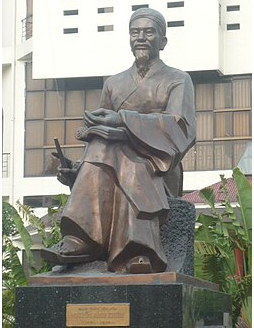
The Confucian scholar of the Nguyễn family, named Bỉnh Khiêm, with the courtesy name Hạnh Phủ and the pseudonym Bạch Vân Cư Sĩ, was later called Tuyết Giang phu tử by posterity. He was born in the year of Tân Hợi (1491), during the reign of King Lê Thánh Tôn, in the 22nd year of the Hồng Đức era, in Cổ Am village (Trung An), Vĩnh Lạc district (now Vĩnh Hảo), Hải Dương province, in the northern part of Vietnam.
His father was Văn Đình, who was later posthumously conferred the title Thái Bảo Nghiêm Quận Công by the Mạc dynasty. His mother was the daughter of the Minister of the Ministry of Household, Nhữ Văn Lâu; she was later posthumously titled as Từ Thục Phu nhân.
From childhood, he was extraordinarily intelligent. At the age of four, he was meticulously taught by his parents, who orally conveyed to him the meanings in the Four Books, Five Classics, and other classical texts. As he grew up, he studied under the scholar Bảng Nhãn Lương Đắc Bằng, a native of Hội Trào village, Hoằng Hóa district, Thanh Hóa province. Nguyễn Bỉnh Khiêm excelled in his studies and became renowned for his literature and poetry.
One day, Lương Đắc Bằng fell seriously ill, realizing he could not survive, so he handed Nguyễn Bỉnh Khiêm a book called Thái Ất Thần Kinh. This book had previously been given to him by the Chinese when he was on a diplomatic mission to China. Nguyễn Bỉnh Khiêm diligently studied the book, and before long, he understood the profound mysteries of Heaven and Earth. From then on, he became famous for his knowledge of astrology and numerology..
When Mạc Đăng Dung usurped the Lê throne, the country was in chaos, and he did not accept an official position. However, the Mạc dynasty required scholars to participate in exams so that the court could select talented individuals to help the nation. Because his elderly mother needed sufficient care and many friends earnestly advised him, he reluctantly went to the capital to take the exams.
At the age of 44, he passed the provincial exam as the first laureate. The following year, in the imperial exam, he became the top laureate, during the Đại Chính era of King Mạc Đăng Doanh.
He was appointed by the Mạc dynasty as Left Director of the Ministry of Personnel and concurrently as Grand Academician of the Đông Các. After serving as an official for 8 years, he submitted memorials to charge and request the King to strictly punish the corrupt officials; but seeing that it was ineffective, he resigned from office (1542, during Mạc Phúc Hải’s reign) and returned to scholarly retirement. When he returned to his village, he built a small retreat for cultivation, named “Bạch Vân Am,” and took the style Bạch Vân Cư sĩ. He also built a summer house by the Tuyết Giang River, named Trung Tâm Quán. Consequently, his disciples later honored him as Tuyết Giang Phu tử.
When Mạc Đăng Dung usurped the Lê throne, the country was in chaos, and he did not accept an official position. However, the Mạc dynasty required scholars to participate in exams so that the court could select talented individuals to help the nation. Because his elderly mother needed sufficient care and many friends earnestly advised him, he reluctantly went to the capital to take the exams.
At the age of 44, he passed the provincial exam as the first laureate. The following year, in the imperial exam, he became the top laureate, during the Đại Chính era of King Mạc Đăng Doanh.
He was appointed by the Mạc dynasty as Left Director of the Ministry of Personnel and concurrently as Grand Academician of the Đông Các. After serving as an official for 8 years, he submitted memorials to charge and request the King to strictly punish the corrupt officials; but seeing that it was ineffective, he resigned from office (1542, during Mạc Phúc Hải’s reign) and returned to scholarly retirement. When.
Not only throughout the entire country of Vietnam, but even the Chinese admired the prophetic talent of ông (Master) Trạng, hence the praise: “An Nam lý học hữu Trình truyền.” (Vietnam has Master Trình, who is proficient in the study of Lý học).
Therefore, from the mandarin officials of the Mạc dynasty to Lord Trịnh and Lord Nguyễn, all wholeheartedly respected him, and frequently visited him to seek his predictions for future events.
Historical records state: When Trạng Trình was gravely ill, Mạc Mậu Hợp, knowing that he was someone who understood both past and future matters, sent his son to visit and inquire about the destiny of the Mạc family. He said: “If there is a calamity later, you should retreat to the Cao Bằng area. Although this place is small, it can shelter a few generations.” The Mạc family heeded his advice; indeed, later, the Lê Trung Hưng dynasty defeated the Mạc dynasty, and the descendants of the Mạc family, losing their power, fled to occupy Cao Bằng and Lạng Sơn, stayed safely there, and ruled for two more generations. In total, the Mạc dynasty lasted for 70 years before ending. There is also a tale: After Nguyễn Kim died, his brother-in-law Trịnh Kiểm took control of the military and killed his brother-in-law Nguyễn Uông.
Nguyen Hoang, being the younger brother and fearing to be implicated, immediately sent someone to seek the advice of the Master. The Master pointed out the ants crawling on the miniature landscape, smiling and saying: ‘A stretch of Hoanh Son, one can live in peace for ten thousand generations.’ Nguyen Hoang understood the meaning, and then asked his sister, Princess Ngoc Bao, to plead with her brother-in-law, Trinh Kiem, to allow him to enter and govern Thuan Hoa land. Thanks to this, Nguyen Hoang had the opportunity to build a long-lasting career, fulfilling the Master’s prophecy.
Trang Trinh also predicted the event of the French losing power in Vietnam, with the date, month, and year exactly accurate:
‘Early spring, rooster crows on the twenty-fourth,
The monk’s term over, the pig blossom ends unusually.’
Early spring indicates the first month, the rooster crowing refers to the year At Dau (1945), twenty-fourth refers to the night of the 24th to the morning of the 25th, and the monk is a wordplay for the French. Therefore, it generally means that the French lost power in Vietnam on the night of the 24th to the early morning of the 25th of the first lunar month in the year At Dau (March 9, 1945) due to Japan’s coup against France.
« Back to Glossary Index