Term: Polaris Star
 « Back to Glossary Index
At that time, the reason why Tử Vi appeared in the sky and shone brightly was to signal that the dark times were about to end, and the Sacred Monarch would emerge to establish a new life. During this period of change, humanity had to endure sorrow and mourning together, which made the Master’s heart infinitely compassionate. Meaning When Positioned in the Houses of Power and Wealth: When the star Tử Vi resides in any house of the horoscope, it usually brings goodness, wealth, and the ability to dispel misfortune to the possessor. It has the potential to prolong life and mitigate some of the malignancy of hostile stars. Personality: People with the Tử Vi star often have a humble, kind, intelligent character and possess leadership abilities. However, they may also encounter weaknesses such as arrogance and lack of decisiveness.
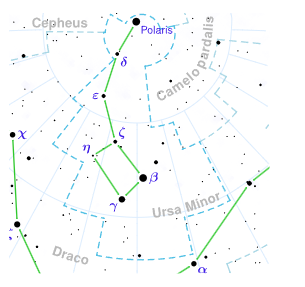
Wikipedia: Polaris is a yellow supergiant star in the northern circumpolar constellation of Ursa Minor. It is designated α Ursae Minoris (Latinized to Alpha Ursae Minoris) and is commonly called the North Star. With an apparent magnitude that fluctuates around 1.98,[3] it is the brightest star in the constellation and is readily visible to the naked eye at night. The position of the star lies less than 1° away from the north celestial pole, making it the current northern pole star. The stable position of the star in the Northern Sky makes it useful for navigation.
Although appearing to the naked eye as a single point of light, Polaris is a triple star system, composed of the primary, a yellow supergiant designated Polaris Aa, in orbit with a smaller companion, Polaris Ab; the pair is almost certainly in a wider orbit with Polaris B. The outer companion B was discovered in August 1779 by William Herschel, with the inner Aa/Ab pair only confirmed in the early 20th century.
As the closest Cepheid variable, Polaris Aa’s distance is a foundational part of the cosmic distance ladder. The revised Hipparcos stellar parallax gives a distance to Polaris A of about 432 light-years (ly) (133 parsecs (pc)), while the successor mission Gaia gives a distance of 446.5 ly (136.9 pc) for Polaris B..
« Back to Glossary Index