Term: Cho Dinh
 « Back to Glossary Index
The market near The Temple pier in Hòa Hảo commune, Tân Châu district (Châu Đốc), that’s why they called it “the Market Temple”.
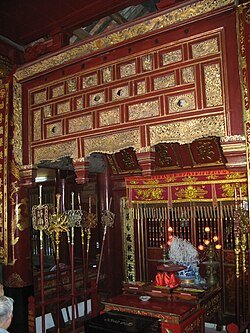
Dinh (Chinese characters: 亭[1] or 庭[2]) is a traditional architectural structure in Vietnamese villages, serving as a place to worship the village guardian deity, people who have contributed to the country, national heroes, and also as a meeting place for the local community.[3]
In the South, village dinh are also called “Dinh than”.
History
In the past, according to the general situation of the country, the dinh of Vietnamese villages was only an inn to rest. In 1231, Retired Emperor Tran Huy Tong issued a decree to erect a Buddha statue at the village inn.[4] In the tenth lunar month of 1491, Le Thanh Tong ordered the construction of Quang Van Dinh outside the Dai Hung gate (now the Nam Gate area, Hanoi),[5] serving as a place for people to drum to report grievances and as a place to announce and explain the policies of the feudal state in Thang Long.
The village communal house, with the function of being a place to worship the village guardian deity and a place for community gatherings, probably began during the early Lê dynasty and took shape during the Mạc dynasty.[6] The development of Confucianism in the late 15th century likely gradually integrated the guardian deity into the village communal house. However, the earliest traces of the village communal house show the guardian deity only from the 16th century. Previously, communal houses usually had only 3 bays and 2 wings. The middle bay did not have a platform; the guardian deity was worshipped there. By the late 17th century, the middle bay extended backward, called the ‘chuôi vồ,’ giving the communal house a ‘Đinh’ shape. By the late 17th century, especially the 18th century, communal houses were supplemented with the front hall. The communal house (in Chinese characters: 亭[1] or 庭[2]) is a traditional architectural structure in Vietnamese villages, serving as a place to worship the guardian deity, people who contributed to the country, national heroes, and also a place for community gatherings.[3] In the South, village communal houses are also called ‘Đình thần.’
« Back to Glossary Index