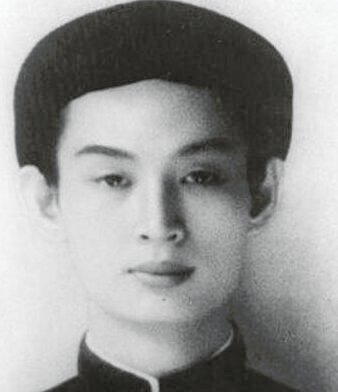
The Sixth Patriarch’s real name was Huệ Năng, surname Lư, with the monastic title Phụ Trung Cư sĩ. He was the son of Lư Khánh Thao and Mrs. Lý Thị. In Mandarin, his name sounds like Hui-Neng.
His original hometown was Phạm Dương, later moving to Tân Châu, in the region of Lãnh Nam.
He was born on the night of the 8th day of the 2nd month in the year Mậu Tuất (638), during the Tang dynasty (China). From the moment he was born, he did not nurse because every night a celestial being gave him Ambrosial water to drink. By the age of three, he was orphaned of his father; his mother remained chaste and raised him in poverty, feeding him only plain vegetables. When he grew up, he specialized in chopping wood to exchange for rice to support his mother. One day, while carrying firewood to the market to exchange for rice, he heard someone reciting the Diamond Sutra up to the line: “One should produce a mind that does not dwell anywhere” (Không trụ vào chỗ nào để sanh tâm mình), and he attained enlightenment and decided to practice. Luckily, someone gave him 10 taels of silver, he provided for his elderly mother, and then went to Đông Thiền temple in Huỳnh Mai district to study with the Fifth Patriarch, Hoàng Nhẫn.
For over eight months, he happily performed temple duties such as chopping wood, pounding rice, carrying water, etc., without complaint, focusing only on the meditation of self-realization: “Directly point to the mind of man, see the nature, and become a Buddha.” One day, the Fifth Master Huang-Ren.
For eight months, he happily carried out tasks such as chopping firewood, pounding rice, fetching water, etc., without any complaint, solely devoted to practicing the method of seeing one’s true nature: ‘Directly point to the human mind, see one’s nature, and become Buddha.’ One day the Fifth Patriarch transmitted to all disciples: each person should compose a verse about their own nature; whoever attains enlightenment will succeed as the Sixth Patriarch. Among the disciples, numbering over a thousand, no one dared to compose; only Shen Tu, who was widely learned, composed a verse and secretly posted it on the wall:
‘The body is a Bodhi tree,
The mind like a bright mirror stand.
Moment by moment wipe it clean,
Do not let dust adhere to it.’
(The body is a Bodhi tree, the mind like a bright mirror stand.
Moment by moment, one must wipe it clean, do not let dust cling.)
This verse was passed around among the followers and reached Huineng’s ears. He immediately went to see and borrowed someone to write his verse on the wall:
‘Bodhi originally has no tree,
The bright mirror also has no stand.
Originally there is not a single thing,
Where can any dust arise?’
(Bodhi originally has no tree, the bright mirror also has no stand.
From the beginning, nothing exists, where can dust adhere?)
Afterward, the Fifth Patriarch came to inspect and realized that Huineng had awakened to the true nature, so he used secret words to call him.
After that, the Fifth Patriarch came to see and realized that Huệ Năng had awakened to his true nature. Therefore, he used secret words to call him into the room, transmitted the mind seal, and entrusted him with the robe and bowl to succeed as the Sixth Patriarch. At that time, it was during the reign of Emperor Tang Gaozong, in the year Tân Dậu of the Long Sóc era. He received the robe and bowl, went to the southern regions to live in seclusion for 16 years before teaching the Dao. On the 13th day of the 8th month of the year Quý Sửu, at Quốc Ân Temple, he gathered his disciples and recited the verse:
“Indifferent, doing no good,
Restless, creating no evil.
Ceasing to see and hear,
The mind is not entangled.”
After finishing preaching, by the time of the third watch, He sat upright and passed away in meditation. During the reign of Emperor Xianzong of the Tang Dynasty, He was granted the honorific title of “Great Supervisor Zen Master” and inscribed on the pagoda four characters “Nguyen Hoa Linh Chieu.” The disciples built a pagoda to enshrine Him at Tao Khê. His physical body did not decay, and the disciples preserved the pagoda to this day.
The magistrate of Thiều Châu erected a stele to record the virtue of the Patriarch to commemorate: “The Patriarch lived seventy-six years. At the age of twenty-four, He received the transmission of the robe and bowl; at thirty-nine, He shaved His head. The Master taught the Dharma for thirty-seven years. Among His disciples, forty-three attained the essence of the school and continued the true Dharma. As for those who attained extraordinary enlightenment, countless as they were, cannot be fully recounted.”
Among the prominent disciples of the Sixth Patriarch were: Thanh Nguyên Hành Tư, Nam Nhạc Hoài Nhượng, Hà Trạch Thần Hội, Vĩnh Gia Huyền Giác, Nam Dương Tuệ Trung, and Pháp Hải, etc. These were key figures. His teachings have also been passed down in the text Pháp Bửu Đàn Kinh; its marvelous and profound meaning is hard to describe, containing the seal of the mind and the true Dharma of Buddhism. Today, the Master Huynh tells us that practicing according to the Sixth Patriarch is practicing rightly according to the Non-Action Dharma of Buddha Shakyamuni.
« Back to Glossary Index