Term: The new-born is naturally good.
 « Back to Glossary Index
This is a phrase from the Three Character Classic, intended to educate people from the moment they learn to read the language of their birthplace.
It can be said that this phrase is inspired by Mencius’s profound philosophy, focusing on the characters for “heart” and “nature.” He inherited and developed Confucius’s view on human nature. Although Confucius did not directly state whether nature is good or evil, he considered nature to be a gift from Heaven (Heaven’s Mandate is Nature).
During Mencius’s time, there were many conflicting opinions surrounding the issue of nature. Some believed that good and evil natures could coexist. Others argued that nature could be either good or evil.
Gaozi even compared nature to rushing water (thoan shui). Water flows east if directed east, and west if directed west. He concluded that nature does not distinguish between good and evil.
Mencius offered a more profound counter-argument. He accepted that water does not distinguish between east and west, but water does distinguish between high and low. Human nature, in doing good, is like water flowing downhill. Mencius’ philosophy asserts: No one is inherently good, and water always flows downwards. Water can be forced to splash onto one’s forehead or blocked on a mountain. But that is due to external forces, not the natural nature of water. Human nature is the same; it is only when external circumstances influence it that it does evil.
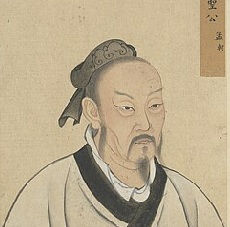
Biography: Mencius (Chinese: 孟子; pinyin: Mèng Zǐ; 372 BC – 289 BC) was a Chinese Confucian philosopher and a successor to Confucius. He is considered the second founder of Confucianism and is revered by later generations as “Second Sage Mencius” (second only to Confucius).
Mencius, whose given name was Meng Ke, and whose courtesy name was Zi Yu, was born during the reign of King Lie of Zhou, in Zou, now Zoucheng City, Shandong Province, China. He was orphaned at a young age and received a strict upbringing from his mother, Lady Zhang (a woman surnamed Zhang). Lady Zhang later became known as Mencius’ mother. Mencius’ mother moved three times to ensure Mencius was in the best social environment for his studies and self-cultivation. In his youth, Mencius was a student of Zi Si, also known as Kong Ji, Confucius’ grandson. Therefore, he was deeply influenced by Confucian thought.
Mencius was an outstanding representative of Confucianism during the Warring States period, a time when hundreds of major schools of thought like Legalism, Confucianism, and Mohism were flourishing. In that historical context, Mencius further developed Confucius’ ideas with the principle that the people are most important, the state comes second, and rulers are least important. He was also the one who proposed the theory of the innate goodness of human nature, saying that people are born good (ren chi so tinh ban thien), in contrast to Xunzi’s idea that human nature is inherently evil (ren chi so tinh ban ac). He believed that ‘those who exert their minds to govern others will be governed by those who exert their strength.’ He promoted his teachings to kings of vassal states like Duke Xuan of Qi (state of Qi), Duke Wen of Teng (state of Teng), and King Hui of Liang (state of Wei), but he wasn’t given much importance. Towards the end of his life, he taught and wrote. His book, the Mencius, is one of the particularly important texts of Confucianism.
Mencius – Vietnamese Wikipedia
« Back to Glossary Index